Wedding Bunting Ideas for Barn and Outdoor Venues
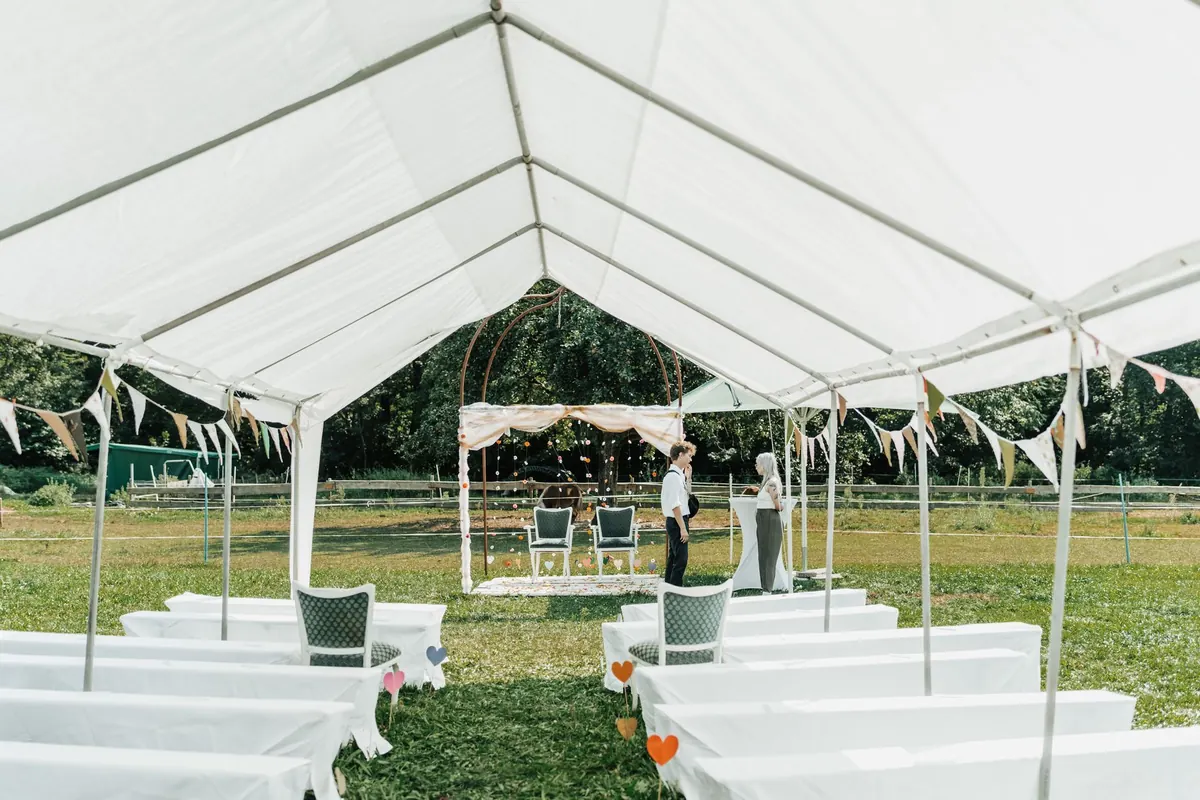
A barn gives you exposed beams, warm timber and a ceiling height no function room can match. A field gives you light, sky and a horizon. Both are superb backdrops for bunting, and both will punish choices that would have been perfectly fine indoors. Outdoors, fabric has to cope with wind, damp grass and falling temperatures, and your handiwork has to look deliberate from thirty feet away as well as from three. These are the decisions that hold up.
Let the Venue Set the Rules Before You Buy Fabric
Measure first. Not the whole room, just the runs you actually plan to dress. In a barn with exposed beams every eight or ten feet, you are working in short spans, and bunting that dips too far in a short span looks tired rather than romantic. In a marquee or an open field you get long, uninterrupted lines, and the eye follows the full length, so repeating patterns and consistent spacing matter far more than any single detail.
Then look at the light. Visit at the hour your reception begins. Dark timber swallows pale pastels and mid-tones; a white marquee bounces light around and can make saturated colors look louder than they did in the shop. Take a scrap of your fabric and hold it against the beam or the wall you plan to use. It feels fussy. It prevents a lot of disappointment.
Fabric That Survives an Outdoor Wedding
Weight and weave do most of the work. Here is how the common options behave once they leave the sewing table:
- Cotton and cotton blends. Matte, sews easily, takes dye beautifully and photographs without glare. Pre-wash and press before cutting, or your flags will shrink unevenly after the first damp evening.
- Calico and unbleached cotton. A soft off-white that suits dried flowers, hessian and wildflower palettes. Slightly heavier than quilting cotton, which helps it hang.
- Linen and linen-look blends. The best drape of the lot. Flags fall into soft folds rather than sticking out stiffly, which reads as expensive in photographs.
- Poly-cotton and flag-weight polyester. Holds color, dries fast and shrugs off a damp evening. A little sheen, so pair it with matte fabrics rather than using it everywhere.
- Outdoor acrylic canvas or oilcloth. For anything staying up overnight or across a wet weekend. Heavy, so it needs stronger line and sturdier fixing points.
- Burlap and hessian. Perfectly rustic, but scratchy, prone to shedding and it smells when wet. Use it in narrow strips or as a backing rather than as the main flag.
Steer clear of slinky satin, which shreds in a breeze, and loose-weave cheesecloth or thin chiffon, which snags on rough timber and droops into a sad line within an hour. If you have your heart set on something delicate, keep it indoors and use it on the cake table instead.
Color Palettes That Hold Their Own
Dark barn interiors reward warmth. Cream, oatmeal, terracotta, sage, mustard, dusty rose, plum and deep teal all read clearly against aged timber and rusted tin, and they sit well with hay-bale gold and brass candlesticks. Pastel pink and baby blue tend to go grey in that light, so if you want them, add a stronger color alongside to anchor them.
In a field, remember that green is a color in your palette whether you planned for it or not. Cream, blush, ochre and soft coral stand out against grass; sage and olive disappear into it. If the venue is already visually busy, with stone walls, hay bales and knotted timber, hold the bunting to three colors plus a neutral. Simple reads as considered.
Hanging Ideas for Beams, Tents, Trees and Open Ground
Barn interiors
Swag from beam to beam with a gentle dip, keeping the drop to roughly a foot or two per run. Small cup hooks or spring clamps work well, but ask the venue first and never assume nails are welcome. Run one line along the loft edge to draw the eye upward, and leave parts of the beams visible. Bunting that covers every surface starts to look like laundry.
Marquees and tent ceilings
The classic zigzag is hard to beat, but space the rows evenly and stop at three or four. Crowding the ceiling flattens the space and makes the room feel lower. Alternate a mixed-color run with a single-color run for rhythm.
Trees and orchard rows
String long lines between trunks at around head height so guests walk under rather than around them. Check for rough bark and sap, which will mark light fabric, and route lines clear of irrigation pipes and low branches. A line strung through a tree canopy looks effortless; a line strung at knee height looks like a trip hazard.
Open fields
With no structure to tie to, you supply your own. Wooden poles set into buckets of sand or concrete, shepherd's hooks, arbor frames and stacked hay bales all work. Keep a shallow sag between posts, anchor every pole against the wind, and pin the line at ground level where it meets the ground. Give yourself a clear, straight aisle for the walk down and the photographs.
Wind, Damp and Weight
Wind is the thing that ruins outdoor bunting, not rain. Shorter runs tangle less, so if the forecast is breezy, split long lines into sections instead of stringing one continuous length across a field. Add a small weight, a washer or a pebble sewn into a hem, at the lowest point of each dip to stop the fabric flapping upward.
Use paracord, jute twine or strong ribbon rather than thin string, and finish knots with a couple of half hitches so they hold. Cotton bunting left out overnight in the rain will stretch and bleed color into whatever it touches, so plan to take it down or accept the risk. Keep every line well clear of candles, fire pits and torches, and check with the venue about their rules on open flame before you hang anything nearby.
Personal Touches Without Clutter
One memorable run beats ten small ideas. Embroider names and a date onto a handful of flags, or piece in fabric from a grandparent's shirt, a favourite dress or a linen tablecloth. Keep it to a single line near the top table or the entrance, where guests will actually stop and look. Varying flag sizes within a run can look charming, but keep the sequence regular enough that it reads as a pattern rather than a mistake.
A Setup Kit Worth Packing
Bunting day always runs short on time, and a missing pair of scissors costs an hour. Pack a labelled bag per run, then add:
- Extra line, spare flags in every color, and scissors.
- Cup hooks, clamps, ground pins and a small mallet.
- Safety pins, fabric tape, and a needle and thread in your main colors.
- A tape measure, a lighter for sealing ribbon ends, and a step stool or ladder if the venue allows one.
- Garden twine and a few small weights for the low points of each dip.
Hang it the day before if you can get access, and put one person in charge of the whole job so decisions get made quickly on the day. Then step back to the far end of the room, or to the edge of the field, and look at it from where your guests will first see it. If the lines are straight, the dips are even and the colors belong to the building, the bunting will look like it was always meant to be there.
Photo: Masood Aslami / Pexels